
Gorilla trekking is a hike, not a climb, and most visitors manage it. That is the honest summary. What surprises people is rarely the distance. It is the altitude, the mud, and the fact that the length of the walk is decided by where the gorillas slept the night before, not by anything you can train for in advance. Here is what the day actually asks of you.
What you are signing up for
The day starts early. You are at the park headquarters in Kinigi shortly after seven in the morning, with your passport, and the rangers sort the day’s visitors into groups of eight and match each group to a gorilla family. Fitness and interests are part of that conversation, so tell them honestly how you are feeling and what you can manage. From there you drive to the trailhead for your family, which can be twenty minutes or an hour, and then you walk.
The walking takes anywhere from half an hour to five or six hours, depending on where the family moved to. Rangers and trackers leave before dawn to find them, so the distance is known on the day and not before. When you reach the family you get one hour with them, and then you walk back the way you came.
The altitude is what catches people
Volcanoes National Park runs from about 2,400 metres up to the summit of Karisimbi at 4,507. Most trekking happens between roughly 2,500 and 3,000 metres, which is high enough to notice if you have flown in the day before. Bwindi sits lower, between about 1,160 and 2,600 metres, but its trails are steeper in short bursts, so it is not automatically easier.
The practical advice is to arrive at least one day before your trek date, to sleep in Musanze rather than driving up on the morning, and to walk slowly and deliberately once you are on the trail. The pace is set by the slowest member of the group, and nobody is left behind or rushed. Guides stop often. If you feel light headed, say so.
The terrain, plainly described
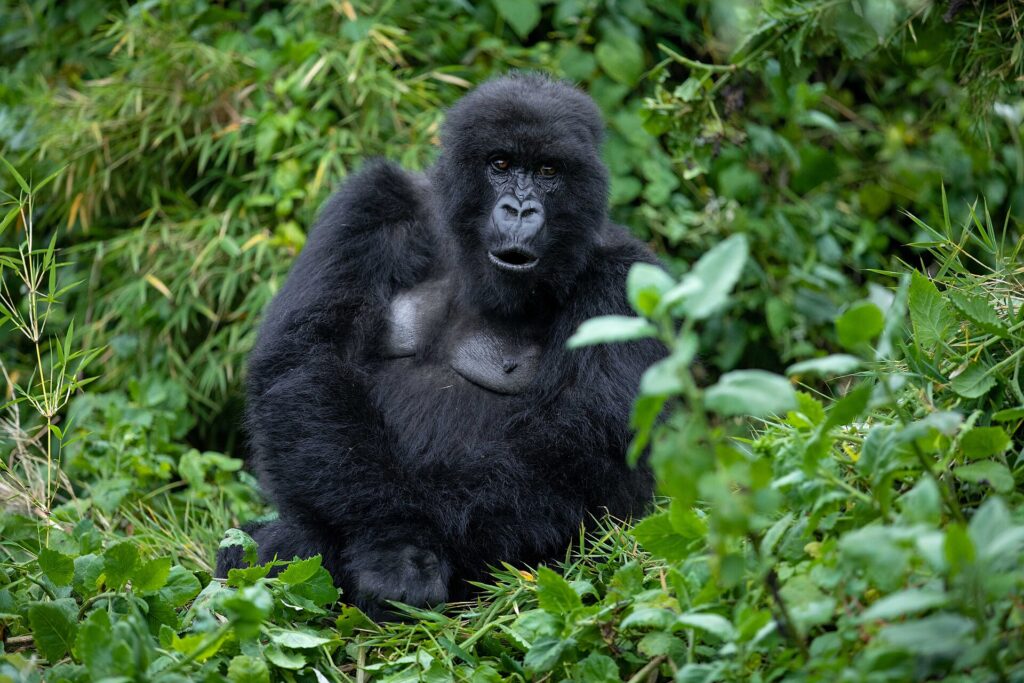
Open bamboo and farm edges at the start, then heavy vegetation: nettles that sting through thin fabric, mud that holds your boot, roots hidden under leaf litter, and slopes that are steeper than the photographs suggest. If the family has moved up towards the saddle between two volcanoes, you will know about it. Fresh volcanic rock underfoot in places, and by the end of a wet morning, a genuinely slippery descent.
Gaiters keep the mud out of your socks, gardening gloves protect your hands when you grab a bamboo stem, and boots with real tread matter more than any other item you pack. Our Rwanda packing list covers the rest, and the gorilla trekking guide goes through what to wear and carry in detail.

Photo: Emmanuel Kwizera / Wikimedia Commons, CC BY-SA 4.0
Who finds it hard
People who are reasonably active at home tend to find the trek easier than they feared. People who are sedentary tend to find it harder than they expected, mostly on the descent rather than the climb. Knees are the usual complaint, along with breathlessness at the start before the body adjusts. Anyone with a heart or lung condition, or with a back problem that flares on uneven ground, should talk to their doctor before booking and to the rangers before setting off.
Age is less of a factor than it sounds. Fit travellers in their seventies trek here every week. The minimum age of 15 is enforced, and children are not permitted, so a family safari with younger children needs to be built around other activities. We covered that in family safaris in Rwanda.
What makes it considerably easier
Hire a porter. They wait at the trailhead, they carry your daypack, and on a wet descent they will take your arm without being asked. The fee is small and it goes directly to families living beside the park boundary, which is one of the most direct ways your visit supports conservation. Walking poles help on the descent. So does a light pack, which means leaving things in the vehicle that you will not use.
If you have limited mobility or a condition that makes uneven ground genuinely unsafe, Rwanda runs a carrying service for gorilla treks, in which you are carried in a purpose-built chair by a team of porters. It is not cheap and it has to be arranged well before you travel, not on the morning. Tell us at the planning stage and we will check availability and pricing for your date.
The hour with the gorillas
When you arrive, the rules are strict and they are the reason the encounter is possible at all. You keep about seven metres away, your hour starts when the family is settled and not before, flash photography is forbidden, and the rangers will reposition you if a gorilla moves towards you. Gorillas share the great majority of our DNA and catch human respiratory illnesses, so anyone arriving with a cough, cold or fever is turned away regardless of what they paid. If you feel something coming on in the days beforehand, tell your guide immediately.
The hour passes faster than anyone expects. Most people put the camera down after ten minutes and simply watch, which is the advice worth taking.
How to prepare, without overthinking it
- Walk up hills with a small backpack for a few weeks before you travel, two or three times a week is enough.
- Fly in a day early and sleep at altitude near the park rather than in Kigali.
- Break in your boots properly, and bring the gloves and gaiters.
- Carry two litres of water and a snack, and let the porter carry it.
- Tell the rangers about any injury, illness or medication that might matter on the trail.
- Pack a rain shell in a dry bag. Mountain weather changes in minutes.
The bottom line
A gorilla trek is a demanding but achievable morning for most adults who can walk for a few hours. It is not a mountain climb, it is not a race, and the guides are excellent at getting everyone to the family. If you can walk slowly uphill for a couple of hours with stops, you can do this. Our guide to gorilla permits explains the cost and booking side, and Rwanda or Uganda compares the two trekking destinations.
Trips built around the trek
Our three day gorilla trekking trip puts you in Musanze the night before your permit date, which is the single best thing you can do for how the trek feels. If you want a second primate morning, four days gorillas and golden monkeys adds the bamboo forests on the easier lower slopes. Both are private, with a driver-guide from Kigali and the pace set by you rather than a group.
Plan it with a local expert
Every Map Start journey is private and can be adjusted to your dates, interests and preferred pace.